
On its own, American Fiction is a great movie. But by making the stories of three Black women integral to the narrative, it elevates itself to a whole other level.
There’s a scene in the movie, American Fiction, in which Coraline, a lawyer who’s recently become involved with Thelonious “Monk” Ellison, a writer and the film’s main character, says to Monk, “You write women characters well.” The same can be said of Cord Jefferson, whose adaptation of Percival Everett’s 2001 novel, Erasure, is a nuanced homage to the generational struggles of Black women.
If the reviews are to be believed, American Fiction is about a struggling writer whose unwillingness to play into racial tropes in his work makes him a commercial failure. Exasperated by the limitations of what it means to be a “Black writer,” he bashes out a novel chock-full of stereotypes and bad language that publishers fall over themselves to acquire. Money and success follow for Stagg R. Leigh, the pseudonym Monk goes by, but they fail to placate Monk himself, who wrestles with the reality of selling out and its implications.
While it’s true that this is the film’s central plot, to leave it at that would be to do it a massive disservice. What makes American Fiction stand out is its masterful take on Black life, specifically Black middle-class family life, and the complexity of the relationships between Black peoples – yes, peoples – because, as Black people everywhere know, we are not a monolith.
To my mind, it is the stories of three Black women that anchor this film and make it exceptional: Agnes Ellison, Monk’s mother, played by Leslie Uggams, Lisa Ellison, Monk’s sister, played by Tracee Ellis Ross, and Lorraine, the longtime help to the Ellison family, played by Myra Lucretia Taylor.
Bound, as they are, in the great themes that overshadow every Black woman’s life – the pursuit of excellence, the weight of gender roles and expectations, colourism, and the age-old search for love when love doesn’t love you back, all set against the pervasive backdrop of class – these characters, brilliantly portrayed, elevate the movie to another level.
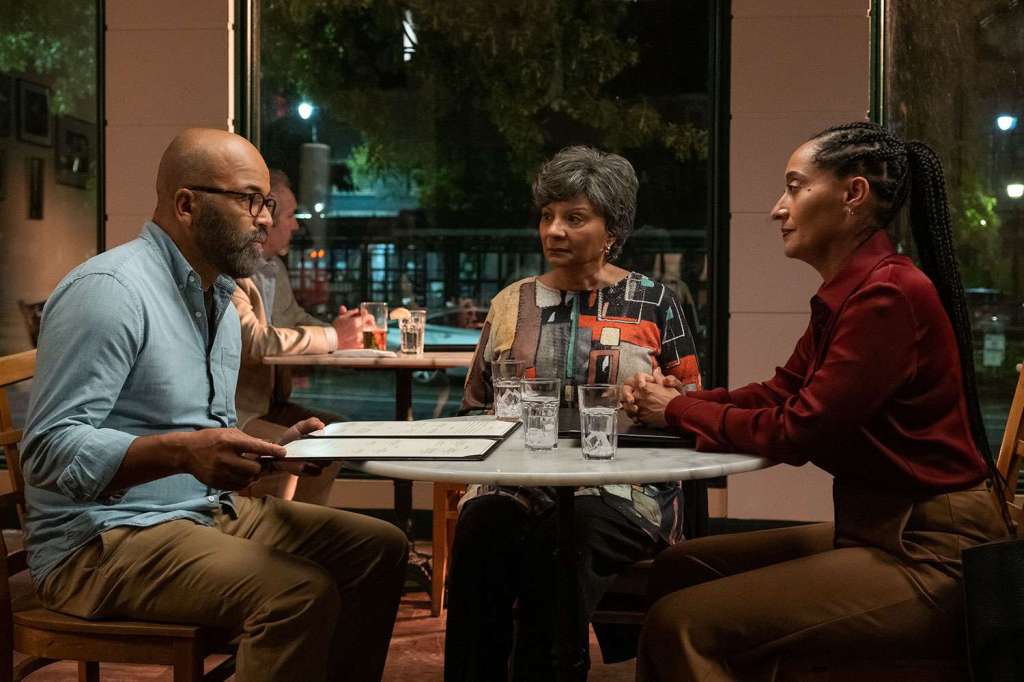
Agnes Ellison is a widowed matriarch in the process of succumbing to Alzheimer’s. We learn that she was cheated on multiple times by her late husband, who killed himself at their beach house. Her children are convinced that their mother didn’t know of her husband’s indiscretions, but every woman watching knows she was fully aware of what went on but chose to look the other way to keep up appearances. For women of a certain class and from a certain age, being married and staying married, whatever the circumstances, is a marker of resilience and loyalty to your family, and to your role as a woman. The fact that Ellison Senior was a doctor and, no doubt, sought-after by Agnes Ellison’s peers, was even more reason not to let such a catch go, the epitome of respectability politics.
With Agnes Ellison’s Alzheimer’s advancing, it falls to Lisa, the only daughter of three siblings, to look after her mother and be responsible for decisions around her care, financially and medically. It’s not the fact that Lisa is a doctor (all the Ellisons are doctors of one kind or another) or a recent divorcee that marks her out for the job of primary carer. No, as a daughter and a single woman without children, she obviously has little else to do and, regardless, it’s her unspoken duty as a woman to assume the labour of care.
It’s no wonder, then – though nonetheless shocking – that Lisa dies suddenly while on a lunch date with Monk, a heart attack doubtless caused by years of carrying the weight of expectations implicit in being a Black woman (#BlackExcellence #BlackGirlMagic) and the only girl child in a family of boys.
But it is in Lorraine, the Ellison’s housekeeper, that all these threads come together. After years of faithfully serving the family and putting everybody first, the quintessential Mammy albeit in a Black household, she finally, finally, gets a chance at love when she becomes engaged to local policeman, Maynard. Now in the twilight of her life and with her labour behind her as Agnes Ellison is placed in a care home, she is at long last free to pursue some kind of life, but not without first seeking the approval of ‘Mr Monk.’ This is the lot of women like her.
While the relationship between Lorraine and the Ellisons is genuine, it is by its nature unbalanced. There’s a touching moment in which Lorraine asks Monk to give her away at her wedding and he graciously accepts. We don’t know anything about Lorraine outside of her role as the help, not even her surname – Where does she come from? Does she have a family of her own? – and while we’re happy that she and Maynard are coming together, there’s a sinking feeling that she’s being handed over into another kind of servitude, even if it’s one of her own choosing.

Lorraine’s presence in the movie serves various functions. As a counterpoint to the relative wealth of the Ellisons, the deep and troubling issue of class within the Black community is glaring, if unexplored. Coupled with class is the issue of colourism, which is embedded throughout American Fiction but, again, never really explored.
When writing “My Pafology,” the satire that would become Stagg R. Leigh’s bestseller, Monk spends a significant amount of time grappling with a line of dialogue on how best to describe one of his no-good character’s skin tone – “Black as midnight,” “Black as coal” – playing up to the deeply held belief that dark-skinned Blacks are inherently deviant. That this is conventional thinking is evidenced by various studies that show, among other things, that dark-skinned Black people are more likely to be convicted of a crime than their lighter-skinned peers and that the darker you are, the less likely you are perceived to feel pain.
If there’s one flaw in the film, and perhaps it is not a fault with the film but with the character of Monk, it’s that it/he never considers how any of these issues directly relate to him. Monk never questions why he instinctively believes it’s his sister’s responsibility to care for their mother, or why their maid, who is often described, and self-described, as being “(like) family” is a dark-skinned, fat woman of late middle-age, the kind of woman who could be in service in any white home. He doesn’t even question why they have a maid at all and the meaning of his privilege. Perhaps the writers would have us believe that a man of Monk’s intellect would have wrestled with these issues long ago, but it’s evident throughout the movie that he lacks the self-awareness that would be a prerequisite for this. [As an aside, it’s worth noting that Monk’s younger gay brother, Clifford Ellison, dazzlingly played by Sterling K. Brown in an award-worthy performance, is also dark-skinned, which may go some way to explaining why, in addition to his sexuality, he is the black sheep of the family].
The fact that much of the analysis of American Fiction fails to mention, let alone reflect on, the integral nature of Black women’s stories to the success of the film, and the crucial themes their stories illuminate, goes to show how ‘Erasure’ is not only a fitting title for the book, but equally applies to how some have chosen to ‘see’ the movie devoid of the essential role women play. Whether this is wilful ignorance or this aspect of the film really did go over their heads is debatable.
American Fiction is a work of art. It challenges, provokes, and entertains, and does so beautifully. If there’s one thing it’s typical of, it’s that we’re living in culturally-rich times in which movies, music, literature, theatre, and art are once again serving a vital function in not just reflecting the times, but confronting them head-on, forcing us to imagine universal alternatives.
It reminds me of 2015 and being in New York City for the first time. That summer, I paid a visit to the Museum of Modern Art to see an exhibition of Jacob Lawrence’s Migration Series while listening to the recently released sophomore album, To Pimp A Butterfly, by the rising young rapper, Kendrick Lamar and reading the just published book, Between the World and Me by Ta-Nehisi Coates, a writer at the peak of his powers.
Perhaps I’m writing this review to remind myself that great art is not only possible, but necessary and imperative, that the onus is on us to write layered stories that are true to the life we know and not the one the world tells us is true.
Header Image: Coraline (Erika Alexander) and Thelonious “Monk” Ellison (Jeffrey Wright) in American Fiction.Claire Folger/Orion Releasing LLC
 Sylvia Arthur
Leave a comment