The compound interest of compound housing

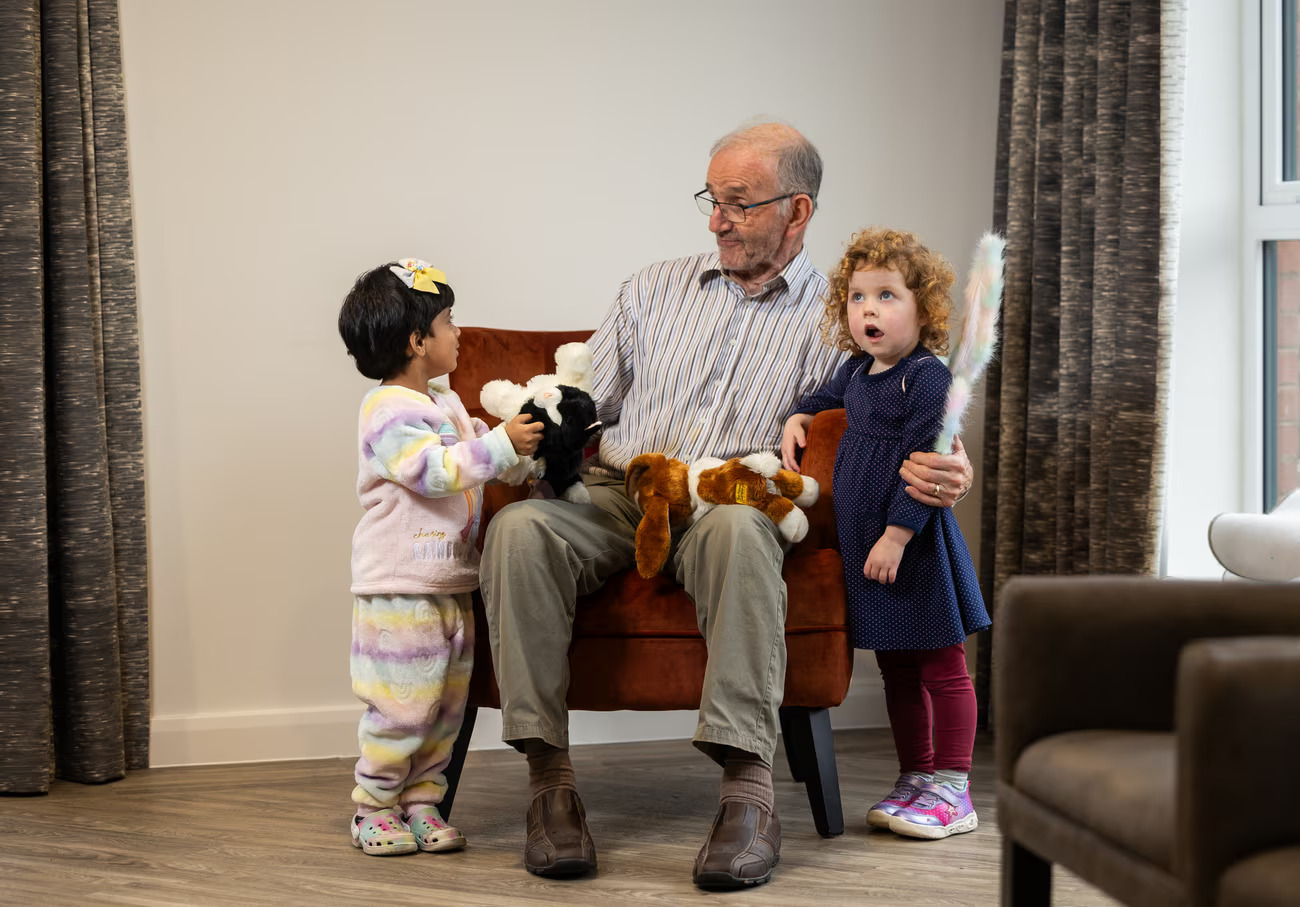
Interesting article in The Guardian about an intergenerational care home in the U.K. that incorporates a nursery where children and residents come together daily, and the positive benefits this has for both seniors and toddlers.

“If the idea is familiar to you,” the article states, “it is probably from the Channel 4 series, Old People’s Home for 4 Year Olds. The show took inspiration from the intergenerational communities that started springing up in Japan in the 1970s.”

Nope! The idea is familiar to me because this is how Africans have always lived, in intergenerational compound houses in which multiple members of the extended family live communally and interact as a matter of course.

The practice of putting old people into care homes is alien in many African cultures. Even those who live in single family dwellings tend to have an elderly relative living with them, looking after the grandchildren while the children look after them, forming a circle of intergenerational care. The benefits of this have long been appreciated by society as a whole, which has known no other way. 

The vast majority of the elder women I interviewed for A Women’s Oral History of West Africa live in compound houses. I would often find them directing things in the courtyard, shouting orders to grandchildren and great-grandchildren like an army general. They drew energy from these exchanges, and from their status as seniors and, by extension, as heads of the household. They drew life.

Ironically, just as the U.K. is coming round to the rewards of such cross-generational social living, particularly for older people, the function of compound houses has changed over the years, now being less about family and more about commerce. (If you’re interested in learning more about this evolution, check out Yinka Ibukun’s excellent Bloomberg article, “How City Life Transformed Ghana’s Compound Houses” with photography by Nipah Dennis).

On a side note, the cost of elderly care in the U.K. is reprehensible. The emotional and psychological toll of finding the money to pay for it is incalculable. Perhaps, in this too, there are lessons to be learnt from elsewhere…

Image: Belong resident Bill Jones with toddlers Serah Savio and Ashleigh Evans. Photograph: Fabio De Paola/The Guardian

2 responses to “The compound interest of compound housing”

  1. R Stannard avatar
    R Stannard

    Hi Sylvia

    Thanks for that link. I found that interesting too.

    I have experience as a Trustee in an early years setting and what I don’t like about this compound care approach is the inference that the early years professionals only have an observational and adjustment role. I worked with a child-led setting where the activities are directed by the children – they are not plonked at tables and put in prams for other people to engage with them. Highly educated professionals in early years are integral community members with crucial roles in supporting families and putting children’s healthy development first.

    Perhaps these sessions are only for short times, but I can’t see how the flow of a day in a child-led playgroup would be supported by this format.

    As you say, it may be better to focus on multi-generational households, something that I thought was common in this country. My grandparents lived with us, for example, and my parents lived with their grandparents. I think the push to home ownership and the reduction of social housing (you’re not allowed spare rooms for example, and it’s makes more financial sense to be single households rather than shared) has a large part to play in the commercialisation of elderly care.

    Also worth noting that the population has been growing older only in the past decade or so with increasingly more complex conditions that come from an elderly ‘body and mind’ on top of frailty, inequality and poverty. For example, my mother didn’t expect to live past 70 (as no one in her family had before her), and wanted to move in with me. We looked into it, but within a year, she was re-married and planning another twenty years of independence.

    I now work in primary and community NHS care, where we are campaigning for a move of funding from hospitals and ‘illness’ to prevention and independence via community care. Without nurses, occupational therapists and a host of other care givers in the community, older people don’t get the support they need to stay at home (whether it’s with family members or on their own). I’ve also worked with the Carers’ Association and the support available for people who care for their parents is appalling, with depression, obesity, poverty and associated bad health being more common among carers than other groups in society.

    I’d be really interested if African communities are facing similar shifts, and also whether we are all seeing another impact of women ‘having it all’. In the UK, being economically active in non-caring roles is rewarded and valued. Women are encouraged to further education and expected to earn a wage. However, the mother’s load is still proven to exist, and society is devaluing child development and caring roles, which are traditionally delivered by women as they are low pay and offer ‘in school’ hours.

    So many thoughts!

    Thank you for the insights and sharing. Always stimulating and interesting to hear your perspective.

    Best wishes,

    Roz

    >

    1. LOATAD avatar

      Thanks so much for reading, Roz, and for such a detailed response informed by your professional expertise and personal experience.

      As you say, so many thoughts! It does seem like the interactions described in the article are somewhat artificial, but the inference seems to be that some form of intergenerational contact is better than none for all parties. While I generally agree with this, it is, indeed, debatable for several reasons as you mentioned and I agree that, from the framing of the article, it sounds as if the early years professionals are somewhat sidelined in this ‘experiment’ in favour of the care staff and the academics.

      It’s really interesting how you describe multigenerational households in the UK using your family as an example. I agree that the push to home ownership and the lack of social housing has helped create a gulf in older people’s care that’s been filled by the business of care homes. In addition, the social dynamics of how we live today, where physical contact is often replaced by virtual contact, means that older people are more vulnerable to exclusion. Ironically, the loneliness epidemic, which runs counter to the idea of multigenerational living, is also a growing problem in Africa. I met a woman who lived surrounded by children and young people but who said she felt lonely. This needs to be looked into and addressed before it becomes as big a problem as it is in the UK and elsewhere.

      I love the example you give of your mother having a second chance at life, so to speak, and planning for a new future. I found this to be true when interviewing elder women in West Africa. In particular, one woman in The Gambia who had been single for many years, which is considered taboo, having been widowed who later decided to marry a man and lives in a pretty unconventional arrangement for the society and culture of which she’s a part. Older women are now making their own rules for their lives having been given “a second chance” and the freedom of ageing, to some extent. This is exciting to witness and paves the way for the next generation of elder women, in particular, to forge their own paths.

      In Africa, though people are dying young compared to their peers in the West, they’re still living longer than ever before with all the attendant issues that raises, which you mention. Healthcare, in particular, needs to adapt to take care of this ageing population, as does finding the best and, possibly, new ways to accommodate them. Compound living for so long has served as a kind of social care system in which families shoulder the ‘burden’ of elder care with little-to-no government support. And therein lies the real challenge, I believe, getting governments to treat ageing with the seriousness and compassion it deserves. Here’s hoping…

      Thanks and all the best,

      Sylvia.

Leave a Reply

Discover more from Sylvia Arthur

Subscribe now to keep reading and get access to the full archive.

Continue reading