-
Annick Balley | 1964-2024

I’m saddened to hear of the passing of Annick Balley, a pioneering journalist and broadcaster who I interviewed at her home in Cotonou, Benin, in October 2022 for A Women’s Oral History of West Africa.
Madame Balley had a long and distinguished career in public service broadcasting, rising to the top of her profession as Editor-in-Chief and Head of Programmes at ORTB, a national television and radio station in Benin.
As a woman in African journalism in the 1980s, she was an exception and it was a struggle to be taken seriously, but with her broad knowledge, nose for a story, and unquestionable talent, she became known as a distinguished and well-respected newswoman. She lived and worked across the continent, from the Democratic Republic of Congo to Burkina Faso and Mali, and she reported on many of Africa’s significant political events.
She didn’t stop there. As someone who was as interested in building journalistic institutions as building a story, she left Benin to manage the pan-African channel, Maisha TV. She also made sure to nurture the next generation of female journalists, mentoring many and creating paths for their advancement where none previously existed. Annick Balley was a force.
Though she leaves a solid legacy, the saddest thing about Madame Balley’s passing is that she never made it to 60, dying two months short of her landmark birthday. Like so many West African women, whose average life expectancy is just 60 years old, her time has been tragically cut short. Fortunately, her life is on record and we know she was here.
Before going to meet Madame Balley, my fixer told me she was 60. It was only when I met her in person that she confirmed her date of birth as April 1964. I was deflated because I knew I couldn’t include her story in the project, but I was honoured to have the opportunity to be in conversation with her, so we continued.
She was short of time that day, there was a breaking news story she was on her way to cover, but she sat down with me and narrated her story generously. She was truly inspirational and, as we were leaving, she encouraged me in my work and said she looked forward to seeing the outcome.
I’ve always felt the pressure to complete this project quickly to ensure that as many of the women who were kind enough to share their stories get to see the outcome. The statistics mean that time isn’t on our side. The premature passing of Madame Balley has shown this. A luta continua.
Rest Well, Madame Balley. We will do our best to continue where you left off.
To learn more about Annick Balley’s remarkable life, read this tribute from her ORTB colleagues here. -
The compound interest of compound housing

Interesting article in The Guardian about an intergenerational care home in the U.K. that incorporates a nursery where children and residents come together daily, and the positive benefits this has for both seniors and toddlers.
“If the idea is familiar to you,” the article states, “it is probably from the Channel 4 series, Old People’s Home for 4 Year Olds. The show took inspiration from the intergenerational communities that started springing up in Japan in the 1970s.”
Nope! The idea is familiar to me because this is how Africans have always lived, in intergenerational compound houses in which multiple members of the extended family live communally and interact as a matter of course.
The practice of putting old people into care homes is alien in many African cultures. Even those who live in single family dwellings tend to have an elderly relative living with them, looking after the grandchildren while the children look after them, forming a circle of intergenerational care. The benefits of this have long been appreciated by society as a whole, which has known no other way.
The vast majority of the elder women I interviewed for A Women’s Oral History of West Africa live in compound houses. I would often find them directing things in the courtyard, shouting orders to grandchildren and great-grandchildren like an army general. They drew energy from these exchanges, and from their status as seniors and, by extension, as heads of the household. They drew life.
Ironically, just as the U.K. is coming round to the rewards of such cross-generational social living, particularly for older people, the function of compound houses has changed over the years, now being less about family and more about commerce. (If you’re interested in learning more about this evolution, check out Yinka Ibukun’s excellent Bloomberg article, “How City Life Transformed Ghana’s Compound Houses” with photography by Nipah Dennis).
On a side note, the cost of elderly care in the U.K. is reprehensible. The emotional and psychological toll of finding the money to pay for it is incalculable. Perhaps, in this too, there are lessons to be learnt from elsewhere…
Image: Belong resident Bill Jones with toddlers Serah Savio and Ashleigh Evans. Photograph: Fabio De Paola/The Guardian
-
The Sarjo Effect

“It’s not like male photographers are better than female. I want people to recognise me as a photographer who is as good as male ones. I want Gambia to see how passionate I am.”
Sarjo Baldeh in The GuardianI’m so pleased for and proud of my friend, Sarjo Baldeh, my photographer on The Gambia leg of A Women’s Oral History Of West Africa, whose empowering story has gone viral.
At just 22, Sarjo is a self-taught camerawoman specialising in football photography. One of only a handful of female photographers in her country, she was also one of just four women photographers at the African Cup of Nations (Afcon) tournament currently being held in the Ivory Coast. Working in a male-dominated profession in a macho sport in a patriarchal society, Sarjo’s passion, determination, and work ethic make her even more exceptional, and a role model for young women and girls looking to break down barriers and enter unconventional fields. This quote from the article perfectly exemplifies her can-do attitude:
“When I came to Afcon I realised that in order to be in same position as male photographers I have to double up my hard work, because they’re taller than me, bigger than me, fitter than me, especially when we have to take squad pictures of the boys – it’s always a push and pull situation [to take the best spot].”
Sarjo has long been making an impact in her community. Two years ago, she set up Team Baldezz to train young women (and a man) in photography skills and the group photographs local league football matches weekly. Here are some takeaways from her story:
– Young women need role models from within their own communities When interviewing women elders about their childhood dreams and aspirations, the majority were baffled by the question, saying they didn’t have any because they didn’t know anything about life outside of their immediate community. Sarjo is well-known locally as “The Woman Photographer” and many young women are starting to believe they too can do something different from what society expects of them because of her example.
– Young women need space to expand
Working within the bounds of her faith and culture, Sarjo has found a way to pursue her passion while respecting and representing her beliefs and heritage. There are many ways for women to assert their independence and carve out their own paths. Not all revolutions are communal events. Sometimes, they’re personal and incremental.– Young women need strong male allies
Family is everything and fathers, in particular, can be an impediment or a huge help. Sarjo’s dad is a respected policeman who supports his daughter in her pursuit of her craft. Others see this and think, ‘If someone like him can champion his daughter to do something like this, then why not me?’I can’t wait to see the impact of ‘The Sarjo Effect’ on women in photography in The Gambia and beyond 10 years from now. More power and support to her!
-
In Communion With Madame Jobe
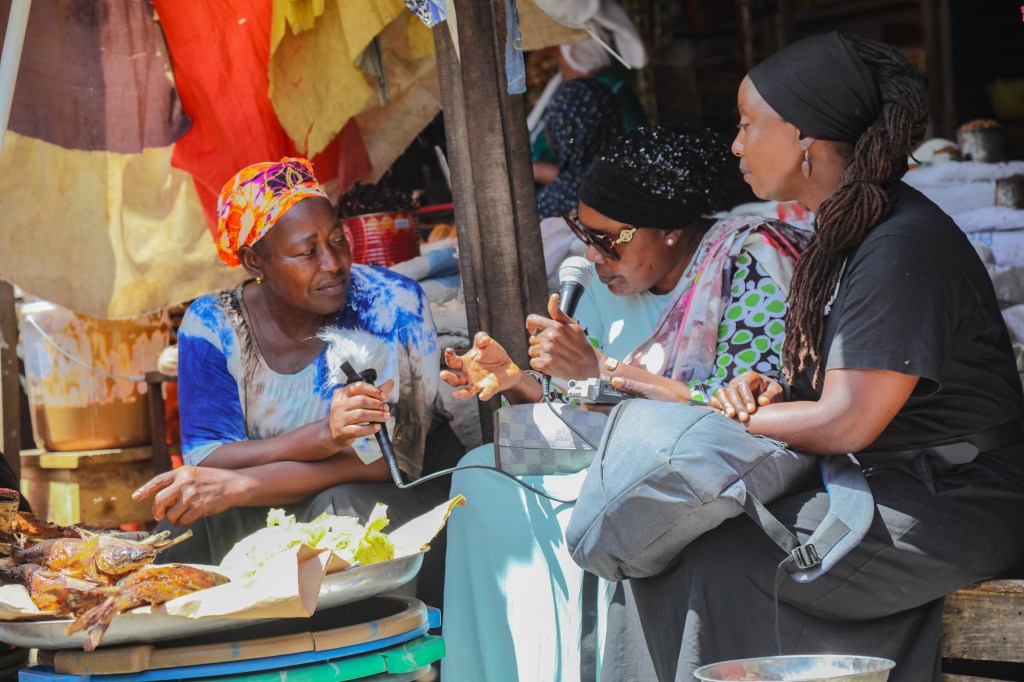
My professional highlight of 2023 was spending five weeks in The Gambia travelling along the Atlantic coast interviewing women aged over 60 about their lives. This fieldwork was part of my research for my National Geographic Society-supported project, A Women’s Oral History of West Africa.
Of the 27 elders I had the privilege to commune with, Madame Jobe’s story struck me the most. My excellent fixer and translator, Awa Senghore and I went to meet her one morning at her stall in the sprawling Serekunda Market and she greeted me with a warmth that was instinctive and kind.
Though she looked strong in body and youthful in face, she told us her eyesight was failing due to years of long days and nights smoking fish over a coal pot, which she sells on her stall with the assistance of her eldest daughter, who was a constant presence. She moved around the kiosk sweeping the floor with a palm frond broom as her baby lay asleep on a mat.
During our hour-long conversation, Madame Jobe spoke of her regret that she didn’t send this daughter, now in her early 30s, to school. As the firstborn girl, it was customary to be kept at home to help your mother with the duties and chores involved in maintaining the family while your siblings, in this case, an older brother and a younger sister, go to school.
It was clear that Madame Jobe wrestled with this part of her story, occasionally fighting back tears. Her daughter was an ever-present reminder of the choices she had made, and their consequences, and her daughter’s resentment was palpable. When I asked Madame Jobe, as I ask all the elders, if there was anything she wished she could change about her life, she replied, without hesitation, “I would send this daughter to school.”
Regrets are only useful if they teach us something. There was nothing Madame Jobe could do now about a decision she had made then, but she could ensure that her granddaughters would have the opportunity that their mother was denied, breaking a generational and cultural cycle. And she had.
Regrets are only useful if they teach us something. In recognising that, Madame Jobe found a pathway through the pain, and smiled.
Image: Madame Jobe (left), with Awa Senghore (middle) and Sylvia Arthur (right) in Serekunda Market, The Gambia. By Sarjo Baldeh.
-
2023 Brittle Paper Literary Person of the Year
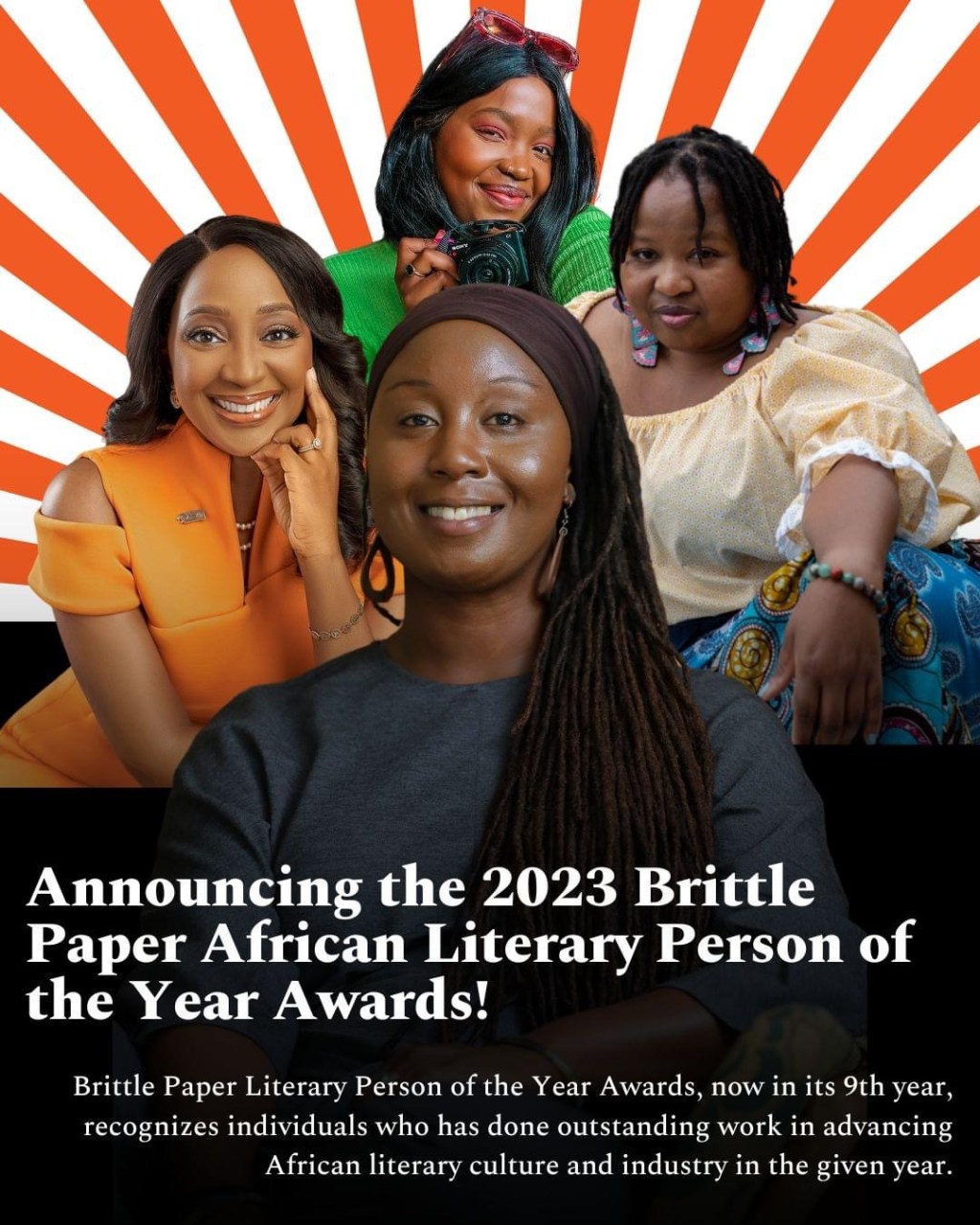
From Brittle Paper:
Sylvia Arthur is the 2023 Brittle Paper African Literary Person of the Year for her outstanding work as the founder of the Library of Africa and the African Diaspora (@loatad_org) in Accra, Ghana. She is the 9th honoree of the award. @NnediOkorafor was the first to receive the award in 2015 and since then it has gone to many outstanding writers and literary industry leaders including Ellah Wakatama, Kwame Dawes, Lola Shoneyin, and others.
Arthur was born in London to Ghanaian parents and did not visit Ghana until she was in her early 20s. In the course of finishing university, receiving a degree in philosophy, a postgraduate diploma in Journalism, and a Master’s in narrative nonfiction writing, she got the idea to establish a library in one of Africa’s most beloved cities.
The Library contains 4000+ books and features exhibitions, film showings, live music and poetry readings. They also feature writing residencies.
Arthur fosters one of the most vibrant and global meeting spaces for Black people, and her selection as the literary person of the year is a celebration of the impact of her work and her vision in creating institutional spaces with significant infrastructural impact on the disseminating of African literature and culture.
Congratulations to all the winners!
SOCIAL MEDIA INFLUENCER OF THE YEAR goes to South African digital content creator Nokukhanya Ntsaluba (Instagram: @pretty_x_bookish) promoting African literature on social media.
PUBLISHER OF THE YEAR goes to Samantha Rumbidzai Vazhure for making space for Shona language literature with her indie press Carnelian Heart Publishing Ltd.
LITERARY PLATFORM OF THE YEAR goes to Akada Children’s Book Festival (@akadafestival) for championing children’s literature in Nigeria.
-
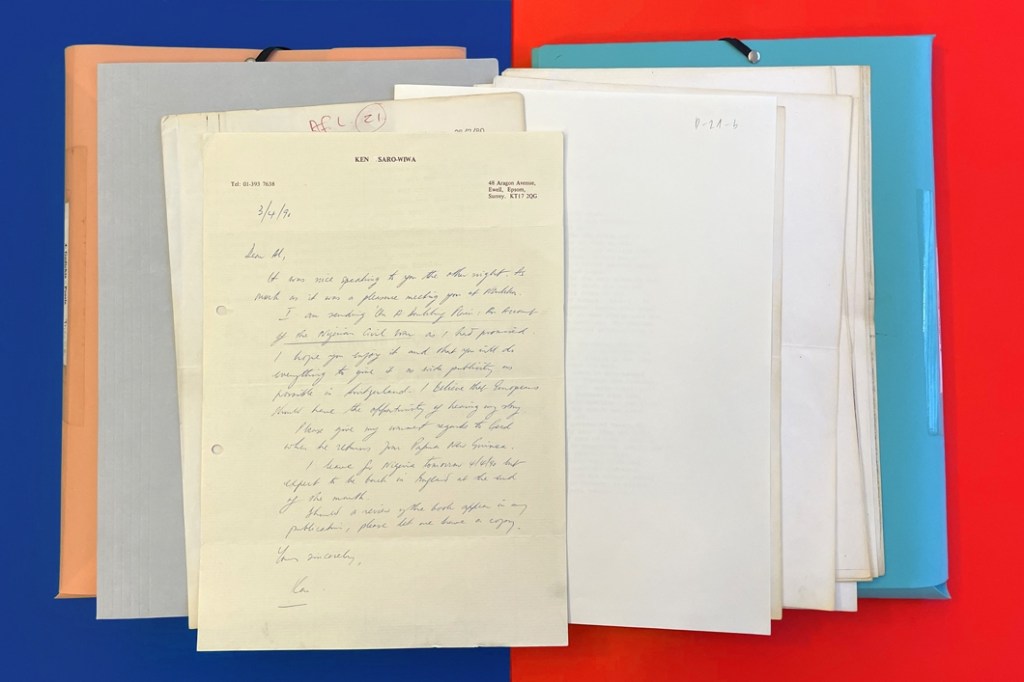
Litafrika talk now online
-
Kwame Nkrumah Festival talk

Left Feminist Biographies
From the Kwame Nkrumah Festival at the University of Ghana, 2021
Following the screening of biographical documentaries on Lorraine Hansberry and Ama Ata Aidoo, this panel brought together several accomplished feminist biographers to discuss lessons that can be drawn from the lives and experiences of revolutionary African women: Claudia Jones, Eslanda Robeson, Suzanne Césaire, Jeanne Nardal, Aoua Kéita, Andrée Blouin and Albertina Sisulu.
-
The necessity of curiosity

I recently had the pleasure of giving a presentation and workshop on my National Geographic Society project to a group of schoolchildren aged between 13 and 16. There were, perhaps, 60 students in total, three groups in three different parts of the world: one in Europe, one in the Caribbean, and one in Africa, Ghana, to be precise. I mention Ghana because it’s relevant to the story.
My presentation lasted about 30 minutes and was followed by a Q&A. I say ‘followed by’ but, in fact, there were a few Q&As throughout the talk, which was energising for me as a speaker.

But while the children in the group from Europe were full of questions and anecdotes relating elements of the talk to experiences in their own lives, those in the group from Ghana were silent. Even when asked directly if they had anything to say about what they’d heard, nothing was forthcoming.
I must admit I wasn’t totally surprised. My experience of working with children and young people in Ghana over the last six years, in both formal and informal settings, has taught me that this seeming indifference – part deference, part lack of confidence – is standard.
I was, however, disappointed. After all, my talk was about African women and was, in large part, about issues they could relate to. What was equally disheartening was that the teacher also had nothing to say.

This inability/unwillingness to speak up, or lack of curiosity, is often put down to culture. Yes, African children are taught to respect and, even, revere their elders, but to the extent that it prevents them from engaging with them on any level that challenges them, even a little, is detrimental. This runs through all sections of society irrespective of class, education, etc. It’s a classic case of children being seen and not heard or, in this case, taught and not learned from.
I’ve seen this behaviour even with adults, the belief that their role in relation to someone older than themselves, even by only a few years, is one of subservience, or unquestioning agreement.
We are doing our children a disservice by not encouraging them / actively discouraging them from being curious. Culture is, of course, important, but so is the opportunity and ability to question things around us. Inquisitiveness is integral to a rich, dynamic, evolutionary life.
One of the slides in my presentation read, “Everyone has the right to be heard.” It was in relation to women of all ages and backgrounds, regardless of their location, having the birthright to tell their story and for it to be given the space to be heard.
But it could also be about children. My hope is that we can come to a place where we are not suppressing their natural curiosity, intentionally or otherwise, in the name of culture or anything else.
Main image: Me teaching creative writing at Gem Star School in Accra, Ghana, January 2019.
-
News: Forbes Africa Feature

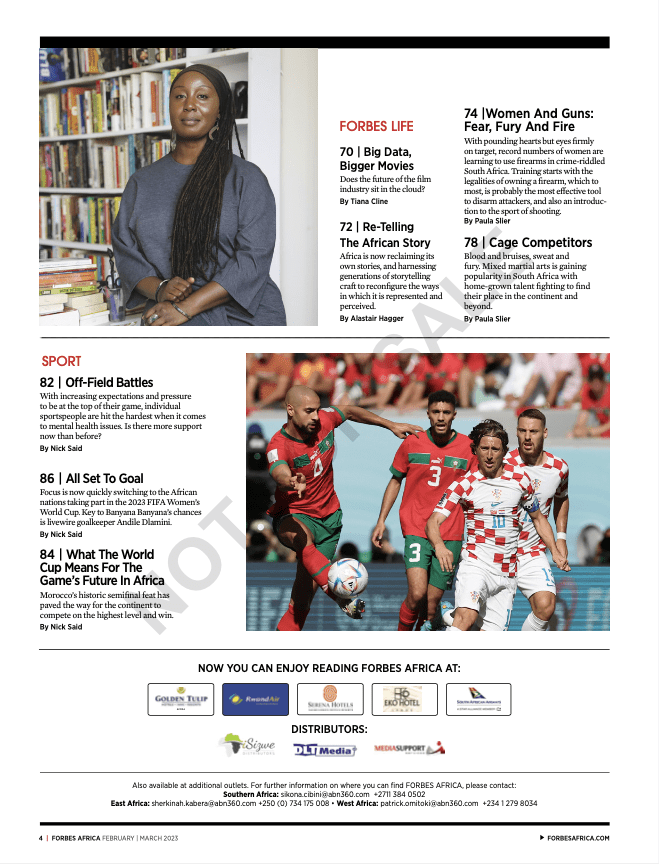
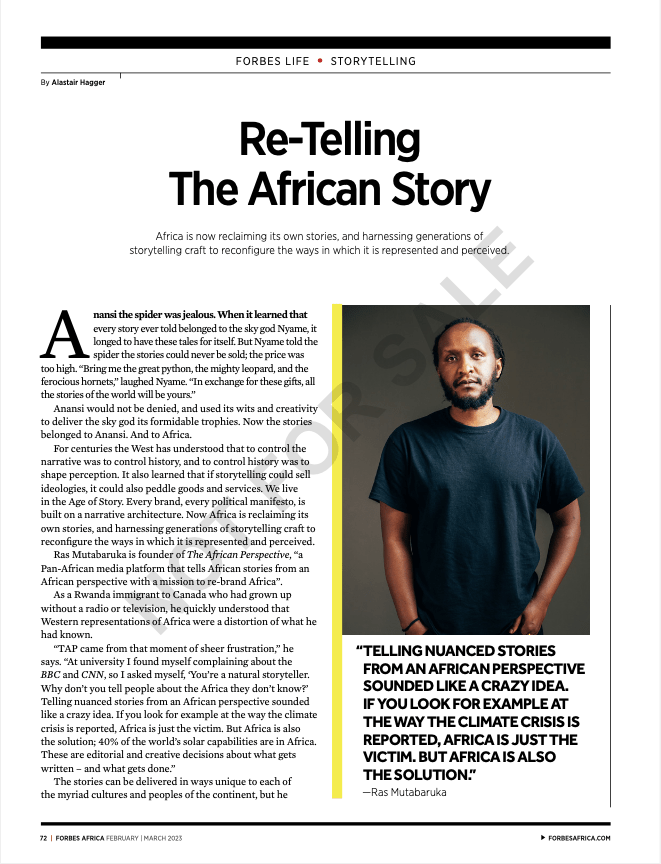
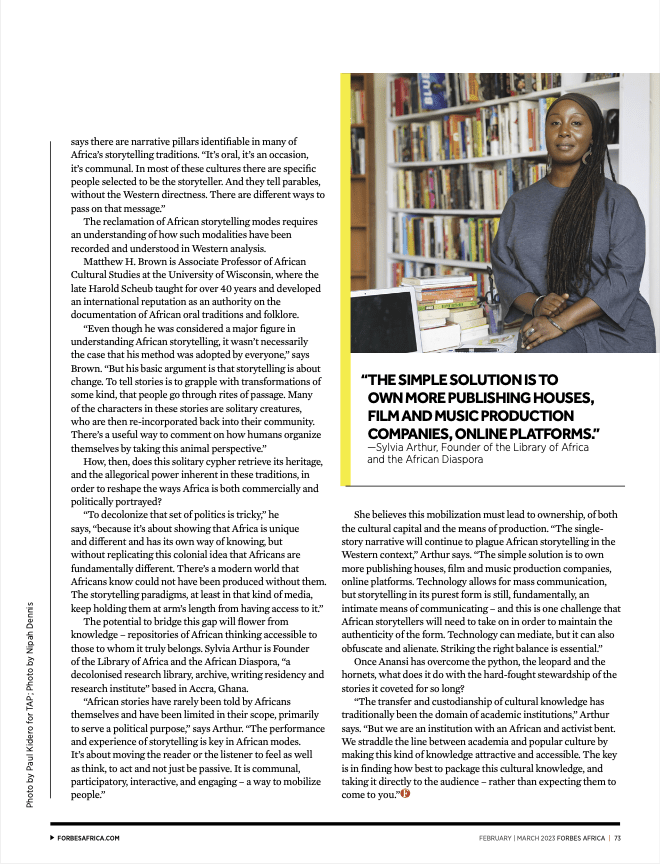
I’m happy to be featured in the February/March 2023 issue of Forbes Africa magazine in an article titled, “Re-telling The African Story”:
“We live in the Age of Story. Every brand, every political manifesto, is built on narrative architecture. Now Africa is reclaiming its own stories, and harnessing generations of storytelling craft to reconfigure the ways in which it is represented and perceived.”
You can read the full story in the Feb/Mar issue of Forbes Africa, available here.
-
To Go or Not, Togo?
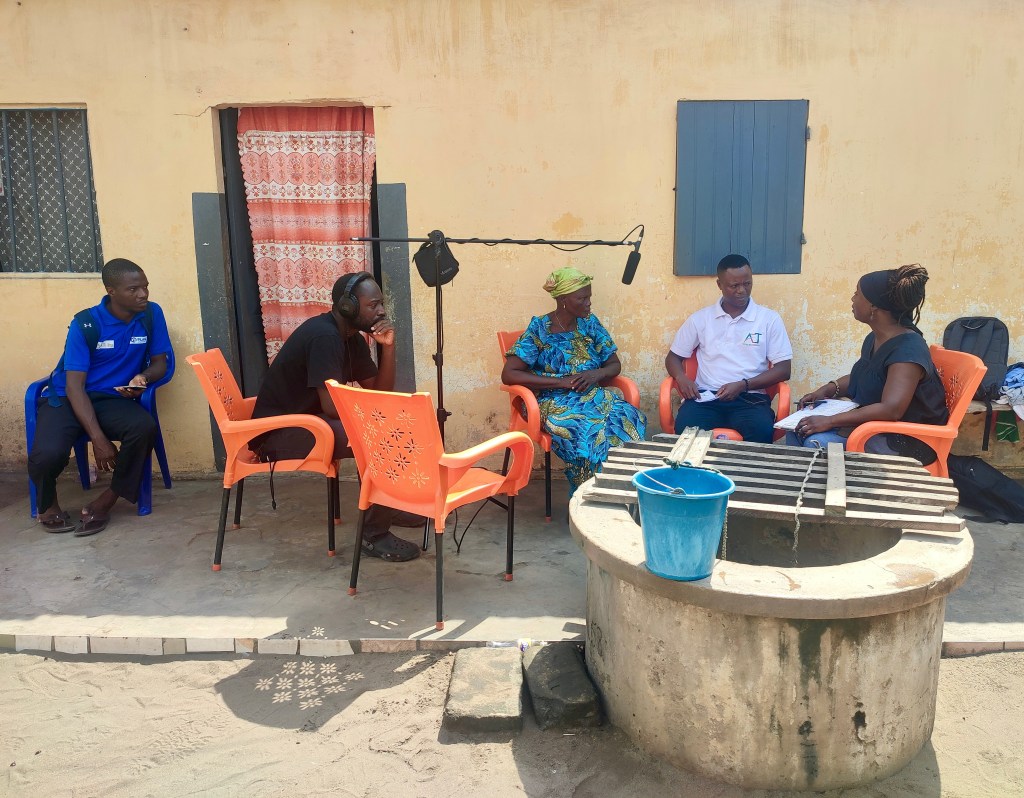
At less than 40 miles and just over an hour by road, the distance between Grand-Popo and Lomé is so short, it’s possible to live in the quiet Beninese fishing town and work in the bustling Togolese metropolis, as thousands do everyday, traversing the border. Yet the process of crossing the frontier, of leaving Benin and entering Togo, and vice versa, is so fraught with frustration, it unnecessarily lengthens the journey and dampens any enthusiasm for the fallacy of frictionless travel, the reality of a borderless ECOWAS region ultimately betraying the dream.
Nevertheless, we arrived in Lomé by bush taxi at around 8.30 on a Saturday morning, when the hustle and bustle of commercial activity was nearing its peak and the taxis, taxi-bikes, and trikes were vying for supremacy on the city’s streets.
Our schedule was unusually tight. We were due to meet seven women who’d been selected by our fixer, Charles, all of whom, he assured us, were eager to talk. But soon after sitting down with the first, it became apparent that it would not be possible to speak with them all, that each of the women deserved the time and attention that would enable them to tell their stories and do them justice.
Here’s a snippet of the stories we heard:
- Madam Kouevi: A rebel spirit who came of age in an era of strict gender conformity, she spoke of how she had dreams of becoming a mechanic or a soldier, but her father and brother forbade her from pursuing these male careers and she became a trader instead.
- Madam Djan: Born in Togo of Ghanaian Krobo heritage, Madam Djan, “at least 75 years of age,” has clear memories of Togo’s independence because she was “this tall and hadn’t yet grown breasts,” but decries the state of the country and the lack of progress since.
- Madam Ayabavi’s parents were actively involved in Togo’s struggle for independence. Her mother, who was one of a group of women activists, was brutally abused by the authorities. Now in her 90s, Madam Ayabavi believes her life then was better than her children’s lives now.
- Madam Ameyo: Describing marriage as suffering, the mother of 10, with four children who have pre-deceased her, says life has taught her many painful lessons. When asked what her advice to young women would be, she warned, “It’s better to be alone than to be in a bad marriage.”
These are just a small selection of the stories that Togo’s senior women have to tell.
With a coastline of just 32 miles and a population of just over eight million, Togo is one of the smallest countries in Africa, as well as one of the narrowest countries in the world. Sandwiched between Ghana to the west and Benin to the east, we travel through Togo to get from our base in Ghana, to one of the four countries that are part of this project, Benin.
Yet Togo is not one of the countries supported by our grant, and we would like to take advantage of our proximity to the country and our contacts to incorporate Togolese women’s stories into the oral archive.
Support us to include Togo as part of this project. Donate to our crowdfunder at ko-fi.com/africanwomenarehistory. Your contribution will enable us to interview more women with fascinating stories to tell to get a more complete picture of the many ways in which #africanwomenarehistory. Visit ko-fi.com/africanwomenarehistory.
Image by Seth Avusuglo
-
Subscribe
Subscribed
Already have a WordPress.com account? Log in now.
 Sylvia Arthur